
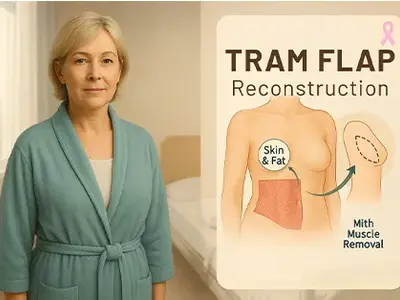




What is TRAM Flap Surgery?
TRAM flap surgery is a type of breast reconstruction. It uses tissue from your lower abdomen to create a new breast shape after mastectomy. TRAM stands for transverse rectus abdominis myocutaneous. This means the procedure uses skin, fat, and part of the rectus abdominis muscle.
There are two main types: pedicled TRAM flap and free TRAM flap. In a pedicled TRAM flap, the tissue remains attached to its original blood supply and is tunneled up to the chest. In a free TRAM flap, the tissue is completely detached and then reconnected to blood vessels in the chest using microsurgery.
This surgery can be done at the same time as the mastectomy (immediate reconstruction) or later (delayed reconstruction). It offers a natural look and feel because it uses your own body tissue.
Understanding the TRAM Flap Procedure and Technique
The TRAM flap procedure involves transferring tissue from the lower abdomen to the chest to reconstruct the breast. It combines plastic surgery techniques with microsurgery or vascular surgery, depending on the flap type. Here's a closer look at how the surgery is done:
Surgical Steps
-
Preparation
The surgeon marks the area on the lower abdomen from which the tissue will be taken. This includes skin, fat, and part of the rectus abdominis muscle. The new breast shape is planned carefully.
-
Tissue Harvesting
A horizontal section of skin and fat from the lower belly is removed. Depending on the type, part of the underlying rectus muscle may also be included. This helps carry the blood supply to the flap.
-
Flap Transfer
-
In a pedicled TRAM flap, the tissue stays connected to its original blood vessels. The flap is then tunneled under the skin to the chest.
-
In a free TRAM flap, the tissue is fully detached. The surgeon reconnects its blood vessels to chest vessels under a microscope. This allows for more precise shaping and better blood supply.
-
In a pedicled TRAM flap, the tissue stays connected to its original blood vessels. The flap is then tunneled under the skin to the chest.
-
Breast Shaping and Closure
The surgeon shapes the transferred tissue into a breast mound. Drains are usually placed to remove excess fluid. The abdominal area is then closed, often resulting in a flatter contour, similar to a tummy tuck.
Duration and Hospital Stay
The surgery usually takes 4 to 8 hours, depending on complexity and whether it is done with mastectomy. Hospital stay ranges from 4 to 7 days. Recovery is longer than with implant-based reconstruction due to the use of muscle and abdominal tissue.
This technique is more complex than some other reconstruction options, but it provides a permanent, natural result using your own tissue.
Comparing TRAM Flap to Other Types of Breast Reconstruction
Breast reconstruction can be done using implants, autologous tissue, or a combination of both. The TRAM flap is one of the most established autologous techniques. Here's how it compares to other common methods:
TRAM Flap vs. Implant-Based Reconstruction
Implant-based reconstruction uses saline or silicone implants to create the breast shape.
TRAM flap uses your own tissue, offering a more natural feel and look.
Key Differences:
-
Natural results: TRAM flap feels more like natural breast tissue.
-
Longevity: Implants may need replacement in 10 to 20 years. TRAM flap results are usually permanent.
-
Scars and recovery: Implant surgery is shorter and has quicker recovery. TRAM flap leaves a scar on the abdomen and requires longer healing.
TRAM Flap vs. DIEP Flap
DIEP flap also uses lower abdominal skin and fat but spares the muscle. It relies on deep blood vessels (deep inferior epigastric perforators).
Key Differences:
-
Muscle preservation: DIEP avoids taking abdominal muscle, reducing the risk of weakness or hernia.
-
Complexity: DIEP is technically more demanding and needs a skilled microsurgeon.
-
Recovery: DIEP may allow faster recovery of core strength, but both require similar healing times.
TRAM Flap vs. Latissimus Dorsi Flap
Latissimus dorsi flap uses skin, fat, and muscle from the upper back. Often, an implant is also used with this flap.
Key Differences:
- Tissue volume: TRAM usually provides more tissue, making it better for single-stage reconstruction without implants.
-
Donor site: TRAM affects abdominal strength, while latissimus dorsi may affect shoulder strength.
In summary, TRAM flap is a good option for women who want a natural reconstruction and have enough abdominal tissue. However, it requires longer recovery and carries risks related to the abdominal wall. Each option has pros and cons, and the right choice depends on your body, health, and personal preferences.
How Surgeons Create a New Breast Using Abdominal Tissue?
To create a new breast using abdominal tissue, surgeons follow a series of precise steps. This process uses your own skin, fat, and sometimes muscle from the lower abdomen. Here's how they do it:
Tissue Selection
Surgeons first identify the best area of tissue on your lower abdomen. This section includes skin and fat that closely matches the texture of natural breast tissue. They may also include a portion of the rectus abdominis muscle to ensure the flap has a reliable blood supply.
Flap Transfer
Depending on the type of TRAM flap:
-
In a pedicled TRAM flap, the tissue remains attached to its original blood supply. The surgeon tunnels it under the skin to move it up to the chest.
-
In a free TRAM flap, the tissue is completely detached. It is then reconnected to blood vessels in the chest using microsurgery.
Breast Shaping
Once the flap is in place, the surgeon shapes the tissue into a breast mound. This requires artistic skill and surgical precision. The goal is to match the natural curve, size, and position of the opposite breast. If needed, adjustments can be made later for symmetry.
Closing the Donor Site
After the flap is transferred, the abdominal area is closed. The surgeon removes the extra skin and pulls the remaining tissue together. This results in a scar similar to that of a tummy tuck. Drains are placed in both the chest and abdomen to help fluid escape and reduce swelling.
This technique allows for a breast reconstruction that looks and feels natural. The result is a warm, soft breast mound that changes with your body over time, unlike an implant.
One of the first EBOPRAS certificated Turkish surgeon There are three main types of TRAM flap procedures. They differ in how much muscle is used and how the blood supply is managed. Each type has its own advantages and limitations, depending on your health, anatomy, and goals. These options offer a range of choices for patients. The best one depends on your body shape, past surgeries, and medical history. A thorough evaluation will help find the safest and most effective method for your needs. You may be a good candidate for TRAM flap breast reconstruction if you meet certain criteria. This procedure is not suitable for everyone. It involves major surgery, and the decision must be based on your overall health and personal goals. If you're considering this procedure, your surgeon will examine your abdomen, review your health history, and possibly order imaging tests. This ensures the safest and most effective approach for your reconstruction. Recovery after TRAM flap breast reconstruction takes time. It involves healing at both the chest and abdominal donor site. Here's what you can expect during the recovery process and in the months that follow: With proper care and realistic expectations, most patients adjust well and are satisfied with the outcome. TRAM flap reconstruction offers several advantages, especially for women who prefer natural results without implants. It has been used for decades and remains a reliable option for many patients. This method is especially suitable for women who have enough abdominal tissue and want a natural, long-term solution. TRAM flap breast reconstruction is a major surgery. While it is generally safe in experienced hands, like all surgical procedures, it carries some risks. The complexity of this procedure comes from using both abdominal and chest areas, and sometimes microsurgery. This is not considered a high-risk procedure for healthy individuals. However, it is more demanding than implant-based reconstruction. Recovery takes longer, and there is a higher chance of issues related to the abdominal wall. Careful patient selection helps reduce risks. Your surgeon will evaluate your risk based on your health, lifestyle, and surgical history. Choosing an experienced surgical team reduces the chance of complications and improves long-term results. TRAM flap and implant-based reconstruction offer different paths to breast restoration. Each has its own benefits and trade-offs. The best choice depends on your health, anatomy, and personal preference. After TRAM flap reconstruction, some patients may need or choose additional procedures to improve symmetry, shape, or appearance. These are usually minor and done weeks or months after the initial surgery. These procedures are typically shorter and less intensive than the main reconstruction. They help improve the final outcome and restore confidence. Typically 4–6 weeks; flap procedures may take longer.Surgeons

Prof. Dr. Arif Türkmen
What Are the Different Types of TRAM Flap Procedures Available?
1. Pedicled TRAM Flap
2. Free TRAM Flap
3. Muscle-Sparing Free TRAM Flap
Am I a Good Candidate for TRAM Flap Breast Reconstruction?
You May Be a Good Candidate If:
You May Not Be a Good Candidate If:
What Should I Expect During TRAM Flap Recovery and Beyond?
Timeline for Healing After TRAM Flap Reconstruction
Early Recovery (First Few Weeks)
Mid-Term Recovery (First 6 to 8 Weeks)
Long-Term Recovery (Months After Surgery)
Beyond Recovery
What Are the Advantages of TRAM Flap Reconstruction?
Main Benefits
The breast is made from your own tissue. It looks and feels more like natural breast tissue than an implant.
Unlike implants, TRAM flap reconstruction does not need future replacements. It ages with your body and maintains shape over time.
The removal of lower abdominal tissue results in a flatter, tighter abdomen. This is similar to the effects of a cosmetic tummy tuck.
Your body is less likely to reject its own tissue. There's also no risk of implant rupture or leakage.
In many cases, TRAM flap reconstruction can be completed in a single surgery. This reduces the need for future procedures.
Potential Complications and Risks
Is TRAM Flap a High-Risk Procedure?
Possible Complications
How Does TRAM Flap Reconstruction Compare to Implant-Based Reconstruction?
Key Differences
Feature
TRAM Flap
Implant-Based
Material
Your own tissue from the abdomen
Saline or silicone implants
Feel
Soft and natural
Firmer, less natural feel
Longevity
Permanent result
Implants may need replacement
Scarring
Scars on chest and abdomen
Scars usually limited to the chest
Recovery Time
Longer (6–12 weeks)
Shorter (2–4 weeks)
Surgical Time
Longer, more complex
Shorter, simpler
Impact on Body
May weaken abdominal wall
No effect on muscle strength
Infection or Rejection Risk
Lower, since tissue is your own
Higher, due to foreign material
What Additional Procedures Might I Need After TRAM Flap Reconstruction?
Common Additional Procedures
If not done during the initial surgery, a new nipple can be created using local skin or grafts. The areola is often colored with medical tattooing.
The opposite breast may be lifted, reduced, or enlarged to match the reconstructed breast.
Small amounts of fat may be transferred to the breast to refine the shape or fill in contour irregularities.
If scars are thick or uneven, they can be revised to improve appearance.
In rare cases, a hernia may develop at the donor site. Surgery can fix this if needed.
Small adjustments to improve the position or fullness of the breast may be done later.
Frequently Asked Questions
Ask the Expert
Free Consultation
Free Consultation
Menu
Language

WhatsApp Contact
Online